
Plastic Scrap Grinder Machine for Injection Molding
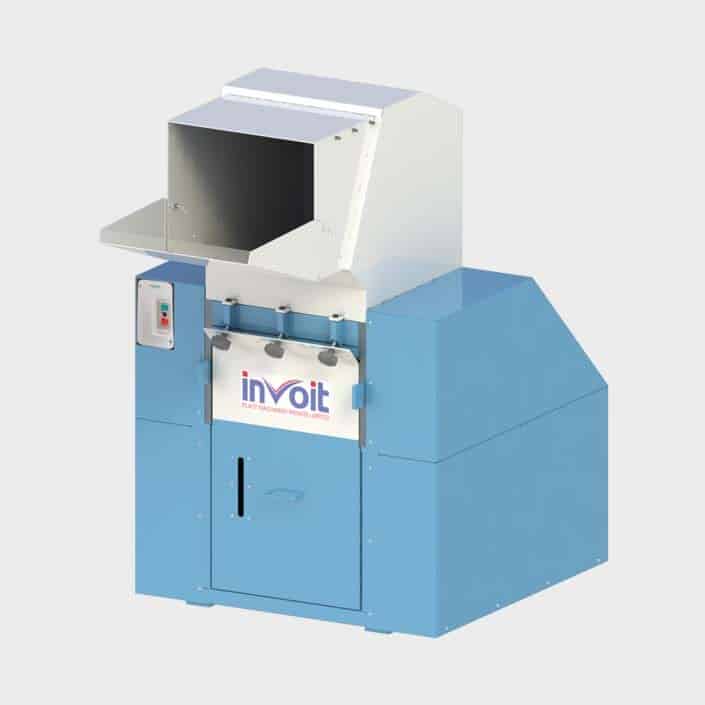
Plastic Scrap Grinder Machine Manufacturer for Injection Molding
Heavy-Duty Industrial Granulators for Sprues, Runners, and Production Rejects
The plastic scrap grinder machine for injection molding manufactured by Invoitplast Machinery Pvt Ltd is engineered to process thermoplastic scrap generated during injection molding cycles. Standard production waste—including cold runners, sprues, vacuum-formed trimmings, and rejected parts—represents a direct loss of virgin raw material if not processed correctly.
This series of injection molding scrap grinder equipment utilizes a high-torque shearing action to reduce bulk scrap into uniform, reusable granules. By integrating this system directly next to the injection molding machine (beside-the-press) or in a centralized recycling area, molding shops can control their material loops, prevent raw material contamination, and reduce the purchase of virgin resins.
Real Challenges of Injection Molding Plants
Injection molding production rarely stops. Machines operate continuously, molds change frequently, and every production cycle generates runners and sprues that must be managed immediately.
Many manufacturers still face common challenges such as:
- Faster scrap processing
- Reduced material handling
- Improved housekeeping
- Better shop floor organization
- Lower raw material consumption
- Reduced production losses
- Consistent regrind quality
- Improved recycling workflow
- Better utilization of production waste
- Higher return on raw material investment
Rather than viewing scrap as a disposal problem, leading manufacturers treat it as recoverable production value.
How the Plastic Scrap Grinder Machine Works in an Injection Molding Plant
In a modern injection molding facility, production waste is generated continuously. Sprues, runners, startup rejects, flash material, short-shot components, and rejected molded parts quickly accumulate around molding machines. If this scrap is not processed efficiently, it occupies valuable floor space, increases handling costs, and locks up reusable raw material.
The Plastic Scrap Grinder Machine for Injection Molding manufactured by Invoitplast Machinery Pvt. Ltd. is designed to fit seamlessly into this workflow. Instead of storing or disposing of plastic waste, the machine converts production scrap into uniform plastic regrind that can be reused according to your material specifications and production standards.
Simple and Efficient Operating Process
The grinding process is straightforward, making it suitable for continuous industrial operation.
Step 1 – Scrap Collection
Plastic runners, sprues, rejected molded products, overflow pieces, and startup waste are collected from the production line.
Step 2 – Material Feeding
The scrap is fed into the grinding chamber through a specially designed hopper that allows safe and smooth material entry.
Step 3 – Precision Cutting
Heavy-duty rotating blades work together with stationary blades to cut the plastic into smaller pieces instead of crushing it randomly. This controlled cutting action helps maintain consistent particle size while reducing unnecessary dust generation.
Step 4 – Screening
The processed material passes through a screen that controls the final regrind size. Only particles that meet the required size are discharged, ensuring a more uniform output.
Step 5 – Ready for Reuse
The finished plastic regrind can be collected for blending with virgin material or used according to your production process and quality requirements.
This efficient workflow helps manufacturers recover valuable material without interrupting production.
| Model No | Feeding Hopper A x B (mm) | Blade | Mesh Hole | Motor | Output (kg/hr) |
Machine Dimension L x W x H (mm) |
Weight (Kg) |
|
| Fix | Rotary | (mm) | KW / HP | |||||
| GRA0800001 | 210 X 185 | 2 | 6 | 8 | 2.2 / 3 | Upto 45 | 700 X 450 X 1000 | 130 |
| GRA1200001 | 310 X 210 | 2 | 9 | 8 | 3.7 / 5 | Upto 60 | 1000 X 750 X 1300 | 300 |
| GRA1600001 | 410 X 365 | 2 | 12 | 10 | 7.5 / 10 | Upto 125 | 1250 X 800 X 1650 | 470 |
| GRA1800001 | 450 X 365 | 2 | 9 | 12 | 11.5 / 15 | Upto 150 | 1250 X 850 X 1650 | 515 |
| GRA2000001 | 510 X 365 | 4 | 15 | 12 | 11.5 / 15 | Upto 180 | 1250 X 900 X 1650 | 535 |
| GRA2400001 | 610 X 570 | 4 | 6 | 16 | 22.5 / 30 | Upto 300 | 2100 X 1300 X 2000 | 1280 |
| GRA2800001 | 715 X 570 | 4 | 6 | 18 | 22.5 / 30 | Upto 350 | 2250 X 1500 X 2200 | 1500 |
| GRA3200001 | 815 X 715 | 4 | 6 | 20 | 30 / 40 | Upto 500 | 2300 X 1500 X 2300 | 1900 |
| GRA3600001 | 915 X 715 | 4 | 6 | 25 | 37 / 50 | Upto 600 | 2400 X 1650 X 2300 | 2000 |
| GRA4000001 | 1020 X 715 | 4 | 6 | 25 | 37 / 50 | Upto 700 | 2400 X 1650 X 2300 | 2200 |
Key Features of Invoitplast Plastic Scrap Grinder Machine
Every feature of our machine is designed with one objective—to help injection molding manufacturers recycle production scrap efficiently while maintaining consistent output quality.
Heavy-Duty Fabricated Body
A rigid machine structure minimizes vibration during operation, ensuring smooth performance even under continuous industrial workloads.
Precision Rotor Design
The specially engineered rotor maintains proper cutting action, allowing efficient grinding of sprues, runners, rejected molded components, and engineering plastic waste.
High-Quality Cutting Blades
Precision-manufactured blades deliver clean cutting performance while helping achieve uniform plastic regrind. Blade design also contributes to longer service intervals and lower maintenance costs.
Optimized Cutting Chamber
The grinding chamber is designed to ensure smooth material flow, efficient cutting, and consistent output while reducing unnecessary material accumulation.
Easy Blade Adjustment
Maintenance teams can access and adjust cutting blades with minimal downtime, helping plants resume production quickly after scheduled servicing.
Efficient Material Discharge
The machine allows continuous discharge of processed plastic regrind, supporting uninterrupted production and easier material handling.
Industrial Safety Design
Operator safety is considered throughout the machine design, ensuring reliable and secure operation under normal industrial conditions.
Low Noise Operation
Compared to conventional grinding systems, the machine is engineered to minimize unnecessary vibration and operational noise, creating a more comfortable working environment.
Why a Dedicated Injection Molding Scrap Grinder Performs Better Than General Plastic Crushers
Many manufacturers initially choose a standard plastic crusher, assuming it can handle all types of plastic waste. Over time, they realize that injection molding scrap presents unique challenges.
Sprues and runners are dense. Engineering plastics are harder. Rejected molded parts often have varying wall thicknesses. These materials require controlled cutting rather than aggressive crushing.
A dedicated runner scrap grinder is specifically engineered for this type of waste. It delivers more uniform particle size, smoother material flow, reduced blade wear, and better overall efficiency when processing injection molding scrap.
This not only improves the quality of the regrind but also reduces maintenance requirements and extends machine life.
Improve Production Efficiency Without Increasing Operating Costs
Every production manager looks for ways to increase output while keeping manufacturing costs under control.
An efficient injection molding waste recycling machine contributes to this objective by helping manufacturers:
- Reduce dependency on virgin raw materials
- Recover valuable production scrap
- Minimize waste handling
- Improve factory cleanliness
- Reduce storage space for rejected parts
- Streamline production workflow
- Lower disposal expenses
- Support sustainable manufacturing initiatives
Instead of viewing scrap as a production loss, manufacturers can integrate waste recovery into their daily manufacturing process.
Built for a Wide Range of Injection Molding Materials
Modern injection molding industries work with many different thermoplastics. Each material behaves differently during grinding, making machine design an important factor in achieving consistent results.
Our plastic regrind machine for injection molding is suitable for processing:
- Polypropylene (PP)
- High Density Polyethylene (HDPE)
- Low Density Polyethylene (LDPE)
- Linear Low Density Polyethylene (LLDPE)
- ABS
- GPPS
- HIPS
- Nylon (PA)
- Polycarbonate (PC)
- PET
- PBT
- PVC (with suitable machine configuration)
- Engineering polymers
- Filled compounds
- Mineral-filled plastics
- Glass-filled plastic components (machine configuration dependent)
Whether your plant manufactures thin-wall packaging or heavy industrial molded products, our machine is designed to deliver reliable grinding performance.
Improve Material Recovery Across Your Production Line
A significant amount of reusable material is often lost because scrap is not processed at the right time. Bags of runners and rejected parts accumulate beside molding machines, occupying valuable production space and creating unnecessary handling work.
Installing an injection molding scrap grinder close to the production area allows waste to be processed quickly and efficiently.
This improves overall workflow by:
- Reducing scrap accumulation
- Improving workplace organization
- Minimizing manual handling
- Simplifying material segregation
- Supporting faster production changeovers
- Improving inventory control for reusable material
Instead of becoming a disposal problem, production scrap becomes part of a structured recycling process within the factory.
Why Manufacturers Across India Choose Invoitplast Machinery Pvt. Ltd.
Buying a plastic scrap grinder machine is not just about comparing motor power or machine dimensions. It is an investment that directly affects production efficiency, material recovery, maintenance costs, and long-term profitability.
At Invoitplast Machinery Pvt. Ltd., we understand that every injection molding plant operates differently. A factory producing automotive components has different recycling requirements than a manufacturer producing household products or electrical parts. That is why we focus on understanding your production process before recommending a solution.
Our goal is simple—to provide a plastic scrap grinder machine for injection molding that fits your application, production capacity, and future growth plans.
Engineering That Matches Real Factory Requirements
Our machines are designed after studying actual production environments rather than relying only on theoretical calculations. Every design decision is made to improve machine reliability, reduce maintenance, and simplify daily operation.
Customized Solutions Instead of Standard Machines
Not every molding plant generates the same type of plastic waste. Some factories process lightweight PP runners, while others deal with thick ABS components or engineering plastics.
We help customers select the right machine configuration based on:
- Material type
- Daily scrap generation
- Required output capacity
- Desired regrind particle size
- Available installation space
- Future production expansion
- Automation requirements
This ensures you receive a solution that performs efficiently today and continues to support your business as production grows.
Supporting Sustainable Plastic Manufacturing
Today, manufacturers are expected to improve productivity while also reducing material waste and supporting sustainable operations.
By recovering production scrap through a plastic scrap grinder machine for injection molding, companies can reduce unnecessary plastic disposal and make better use of valuable raw materials.
Benefits include:
- Lower production waste
- Better material utilization
- Reduced environmental impact
- Improved resource efficiency
- Cleaner production areas
- More sustainable manufacturing practices
Efficient in-house recycling is becoming an important part of modern injection molding operations, helping manufacturers balance productivity with responsible resource management.
Ready to Upgrade Your Injection Molding Scrap Recycling Process?
Whether you are setting up a new molding facility or upgrading an existing recycling system, Invoitplast Machinery Pvt. Ltd. offers dependable grinding solutions tailored to your production needs.
Contact Us Today
Get a Free Quote for your custom-built Plastic Scrap Grinder Machine and experience the precision and performance that define Invoit Plast.
FAQs
A Plastic Scrap Grinder Machine for Injection Molding is an industrial recycling machine designed to grind plastic production waste such as sprues, runners, rejected molded parts, startup waste, and overflow material into reusable plastic granules. It helps manufacturers recover valuable raw materials, reduce production waste, and lower overall manufacturing costs by enabling in-house plastic recycling.
Injection molding companies use plastic scrap grinder machines to recycle production scrap instead of disposing of it. By converting runners, sprues, and rejected parts into reusable regrind, manufacturers can reduce virgin material consumption, improve material recovery, minimize waste handling, and support sustainable manufacturing practices while lowering production costs.
An industrial plastic scrap grinder can process various types of injection molding waste, including:
- Plastic sprues
- Runners
- Rejected molded parts
- Startup scrap
- Overflow material
- Flash
- Short-shot components
- Plastic trimmings
Depending on machine configuration, it can handle materials such as PP, HDPE, LDPE, LLDPE, ABS, HIPS, GPPS, Nylon (PA), Polycarbonate (PC), PET, PBT, PVC, and other engineering plastics.
A Plastic Scrap Grinder Machine works through a controlled cutting process instead of impact crushing.
The process includes:
- Collecting injection molding scrap.
- Feeding the material into the hopper.
- Cutting the plastic using rotating and stationary blades.
- Passing the material through a screen for uniform particle size.
- Collecting the finished plastic regrind for reuse in production.
This process produces consistent granules while reducing dust generation.
A Plastic Scrap Grinder uses precision cutting blades to shear plastic into uniform granules, making it ideal for injection molding scrap like runners and sprues.
A Plastic Crusher generally uses impact force to break plastic into irregular pieces, which can generate more dust, inconsistent particle sizes, and higher blade wear. For injection molding applications, a dedicated plastic scrap grinder typically delivers better regrind quality and more efficient recycling.
Yes. Plastic regrind produced by a properly designed plastic scrap grinder can often be blended with virgin raw material and reused in manufacturing, depending on the plastic type, product quality requirements, and processing standards. This helps manufacturers recover material value and reduce raw material expenses.
Plastic Scrap Grinder Machines are widely used in industries such as:
- Injection Molding
- Automotive Plastic Parts Manufacturing
- Household Plastic Products
- Electrical & Electronics Components
- Packaging Products
- Medical Plastic Components
- Furniture Manufacturing
- Industrial Plastic Components
- Consumer Goods Manufacturing
- Plastic Recycling Plants
These industries use grinders to recycle production waste efficiently and improve material utilization.
Installing a beside-the-press plastic scrap grinder offers several advantages, including:
- Immediate recycling of runners and sprues
- Reduced scrap accumulation
- Lower material handling costs
- Improved factory cleanliness
- Better workflow efficiency
- Reduced storage requirements
- Faster material recovery
- Lower dependence on virgin plastic
This setup helps maintain continuous production while maximizing material recovery.
A Plastic Scrap Grinder helps reduce manufacturing costs by:
- Recovering reusable plastic material
- Lowering virgin raw material consumption
- Reducing waste disposal expenses
- Minimizing manual handling
- Improving production efficiency
- Reducing storage space requirements
- Supporting continuous in-house recycling
Over time, these benefits contribute to improved operational efficiency and a better return on investment.
Before purchasing a Plastic Scrap Grinder Machine, manufacturers should evaluate:
- Plastic material type
- Daily scrap generation
- Required grinding capacity
- Desired particle size
- Machine durability
- Blade quality
- Ease of maintenance
- Power consumption
- Available factory space
- Future production expansion
Choosing the right machine ensures reliable performance and long-term productivity.
Yes. Many industrial plastic scrap grinder machines are designed to process engineering plastics such as ABS, Nylon (PA), Polycarbonate (PC), PET, PBT, and other high-performance polymers. The exact material compatibility depends on the machine configuration, rotor design, blade selection, and application requirements.
Invoit Plast Machinery Pvt. Ltd. manufactures industrial Plastic Scrap Grinder Machines designed for efficient recycling of injection molding waste. The company focuses on application-based machine selection, robust engineering, reliable performance, easy maintenance, and customized solutions tailored to different production capacities and plastic materials. Their machines help manufacturers improve material recovery, reduce production waste, and support cost-effective in-house recycling.