
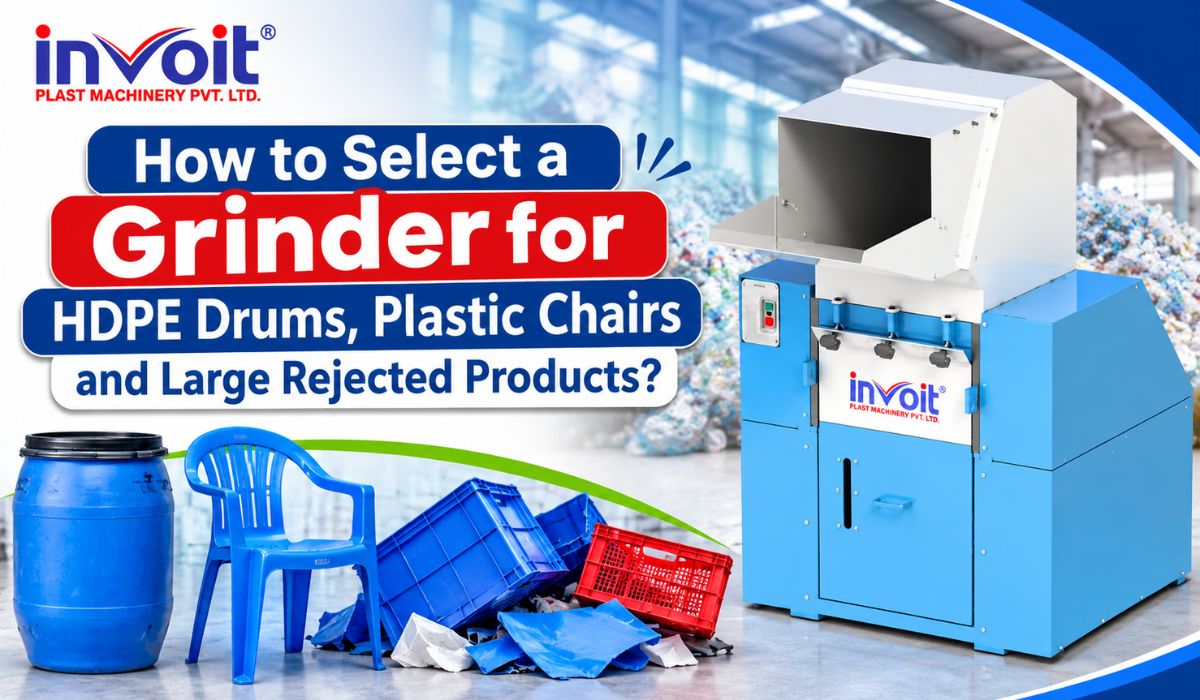
How to Select a Grinder for HDPE Drums, Plastic Chairs and Large Rejected Products?
Plastic recycling and in-house scrap recovery can quickly stall plant efficiency when bulky, high-strength items enter the rejection line. Molded plastic chairs, 200-liter HDPE chemical drums, large storage crates, automotive bumpers, and thick-walled rejected parts present complex physical challenges during size reduction.
Unlike thin films or small injection runners, these large-volume scrap items possess massive internal air volume, extreme impact resistance, high wall thickness, and rigid structural ribs. Feeding them into standard or under-powered crushers frequently leads to material flyback, severe throat bridging, rotor stalls, knife chipping, and premature motor burnout.
Selecting the right industrial plastic scrap grinder (granulator) requires matching machine mechanics with material characteristics. This technical guide outlines the exact engineering criteria, blade geometry, throat size, drive dynamics, and operational setups required to process large rejected plastic products cleanly, continuously, and profitably.
Understanding the Scrap Material Profile: Why Standard Crushers Fail
Before evaluating machine models or motor sizes, analyze the structural behavior of your primary scrap stream. Each scrap type places distinct mechanical demands on the cutting mechanism.
1. 200 Ltr HDPE Drums & Chemical Barrels (High-Molecular Weight HDPE)
- Material Properties: High strength-to-density ratio, high molecular weight (HMW-HDPE), exceptional toughness, and heavy wall thickness at top/bottom rims.
- The Mechanical Challenge: HDPE resists blunt force. Instead of shattering upon impact, it deforms and absorbs shock. Standard rotor blades slide over smooth, curved drum surfaces, causing the drum to bounce over the cutting zone without being pulled in.
- Engineering Fix: High-torque progressive shear cutting (scissor cut action) combined with aggressive rotor blade profiles to bite immediately into smooth cylindrical walls.
2. Molded Plastic Chairs & Crates (PP & HDPE Blends)
- Material Properties: Wide surface area, high structural rigidity, deep reinforcement ribs, and thin-to-medium wall thickness.
- The Mechanical Challenge: The primary obstacle is physical volume, not material thickness. A full-sized plastic chair creates a massive footprint. If the feed throat is narrower than the chair’s widest point, operators must manually chop or pre-cut parts before feeding—adding labor costs, slowing down throughput, and introducing workplace safety risks.
- Engineering Fix: Extra-wide chamber feed throat combined with an open-style rotor geometry that creates high internal suction to draw bulky frames directly into the knives.
3. Large Rejected Molded Parts, Heavy Purging Lumps, & Thick Blow Mold Waste
- Material Properties: Dense mass, uneven geometry, thick sections (15mm to 50+ mm), and unpredictable impact resistance.
- The Mechanical Challenge: Thick scrap subjects drive components to sudden impact shock loads. Lower-grade frames vibrate excessively, while light drive shafts risk bending or breaking under peak torque spikes.
- Engineering Fix: Heavy-duty reinforced steel frames, oversized alloy steel rotor shafts, and heavy flywheels that store kinetic energy to smooth out torque spikes.
Technical Evaluation Criteria for Heavy-Duty Plastic Scrap Grinders
To select a machine that delivers high hourly throughput and long service life without constant downtime, evaluate the following structural specifications.
A. Feed Throat Opening & Hopper Architecture
The hopper throat dimensions (Width x Length) dictate the maximum size of scrap you can process intact.
- For Plastic Chairs & Crates: Throat width must exceed the widest point of the chair frame (typically 600 mm to 1000+ mm).
- For 200L Drums: Feed chamber openings must range between 800 mm and 1200 mm to swallow whole barrels without manual pre-cutting.
- Hopper Safety Features: Look for sound-insulated double-wall hoppers equipped with internal curtain baffles. This prevents high-speed material flyback (kickback) out of the feed chute, protecting operators and maintaining a clean work floor.
B. Rotor Configuration & Cutting Knife Layout
The rotor dynamics determine how effectively material is grabbed, sheared, and discharged:
- Scissor-Cut (V-Type) Blade Layout: Rather than flat impact chopping, opposing angular rotor and bed knives cut material progressively like scissors. This reduces:
- Peak power spikes by up to 30%
- Fines, dust, and thermal buildup
- Noise levels during operation
- Staggered / Solid Rotor Design (Best for Thick HDPE Drums & Heavy Moldings):
- Features shorter, heavy-duty blades staggered around the rotor perimeter.
- Concentrates cutting force on smaller surface segments, delivering immense cutting torque to shear through thick drum rims and solid runner blocks.
- Open-Type Rotor Design (Best for Hollow Chairs, Buckets, & Crates):
- Maximizes airflow through the cutting chamber to prevent heat-sensitive PP/HDPE from melting or smearing.
- Creates aggressive pull-down action, preventing hollow parts from riding top-of-rotor waves.
C. Rotor Shaft Diameter, Flywheel Inertia, & Drive Mechanics
Grinding high-impact polymers generates massive resistance:
- Heavy Flywheel Integration: A precision-balanced, high-mass flywheel mounted opposite the drive pulley stores rotational kinetic energy. When a heavy HDPE drum base enters the blades, flywheel inertia carries the rotor through the cut without stalling the electric motor.
- Alloy Steel Shafting: The central rotor shaft must be forged from high-tensile alloy steel, ground, and dynamically balanced to eliminate vibration-induced fatigue on bearing housings.
- External Heavy-Duty Bearings: Bearings should be housed externally outside the cutting chamber, separated by labyrinth seals. This prevents fine plastic dust from entering bearing races and eliminates heat transfer from the grinding zone into the lubrication grease.
D. Blade Steel Metallurgy & Heat Treatment
Cutting performance relies directly on blade quality. Using mild steel or un-hardened tool steel results in rapid dulling, high power consumption, and excessive dust.
- Standard Industrial Grade: High-Carbon, High-Chromium D2 (AISI D2) / SKD-11 tool steel.
- Properties: Vacuum heat-treated to 58–60 HRC (Rockwell Hardness), offering superior wear resistance against tough polymers and minor surface friction.
- Sharpening Margin: Knives should feature adequate regrindable thickness, allowing multiple resharpening cycles on a surface grinder before replacement is needed.
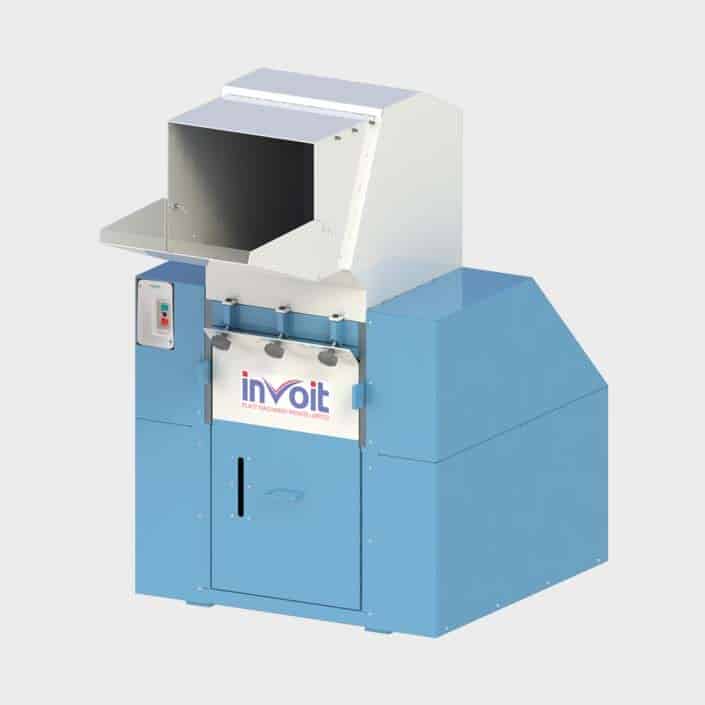
Engineering Specification Matrix by Scrap Category
Use this selection matrix to match your scrap profile with machine dimensions, rotor specs, and drive capacity:
Selection Parameter | Plastic Chairs & Large Crates | 200 Ltr HDPE Drums & Barrels | Heavy Molded Rejections & Lumps |
Material Types | PP, HDPE | HMW-HDPE, PE-100 | PP, PE, ABS, PC, Nylon 6/66 |
Scrap Geometry | Bulky, thin-to-medium wall | Hollow, thick rim, high impact | Heavy wall section, variable shape |
Recommended Rotor Type | Open Rotor / V-Cut Scissor | Heavy-Duty Staggered / V-Cut | Solid Staggered / Heavy Segmented |
Throat Size (A $\times$ B mm) | 600 x500 mm to 1000x 800mm | 800 x 600 mm to 1200 x 900 mm | 600 x 600 mm to 1000 x 800 mm |
Rotor Diameter | 400 mm – 630 mm | 500 mm – 800 mm | 400 – 700 mm |
Drive Power (HP / kW) | 30 HP to 60 HP (22 kW – 45 kW) | 50 HP to 125+ HP (37 kW – 93 kW) | 40 HP to 100+ HP (30 kW – 75 kW) |
Screen Mesh Size | 8 mm – 12 mm | 10 mm – 15 mm | 8 mm – 12 mm |
Throughput Target | 300 – 800 kg/hr | 400 – 1500 kg/hr | 250 – 1000 kg/hr |
Operational Pitfalls to Avoid When Purchasing a Plastic Grinder
Investing in plastic size-reduction machinery requires long-term operational planning. Avoid these common industry mistakes:
1. Undersizing Motor Power to Lower Initial Capital Cost
Attempting to process 200L HDPE drums with an underpowered 20 HP motor results in frequent thermal overload trips, rotor jams, incomplete cuts, and premature motor winding burnout. Match motor horsepower to peak impact requirements, not just average hourly throughput.
2. Overlooking Machine Maintenance Access
Changing rotor and bed blades, clearing chamber jams, or swapping screen plates can take hours if access is poor. Choose granulators equipped with hydraulic or mechanical hopper tilting systems and split-body screen cradles to reduce maintenance downtime from hours to minutes.
3. Ignoring Material Discharge & Dust Handling Integration
Allowing ground regrind to fall into a collection box under the machine creates manual labor bottlenecks, floor dust, and static material cling. Integrating a pneumatic blower system, cyclone separator, and dust removal system transfers regrind directly into storage silos or big-bags cleanly and continuously.
4. Ignoring Screen Hole Geometry and Heat Buildup
Using screen mesh holes that are too small for high-throughput HDPE grinding restricts discharge, keeping material inside the chamber longer. FRICTION → HEAT GENERATION → MATERIAL MELTING. Ensure proper screen hole sizing (10 mm – 15 mm ) paired with adequate chamber evacuation airflow.
Industrial Granulator Solutions by Invoit Plast Machinery Pvt. Ltd.
Based in Ahmedabad, Gujarat, Invoit Plast Machinery Pvt. Ltd. designs and manufactures heavy-duty plastic processing machinery built to perform under demanding industrial conditions across India and international markets.
Our scrap grinder and granulator series are engineered specifically for continuous recycling of bulky injection molding waste, blow molding rejections, and post-industrial polymers.
Key Engineering Advantages of Invoit Plast Granulators:
- Heavy-Plate Welded Construction: Built with heavy-gauge structural steel plates, stress-relieved to handle severe vibration and heavy impact loads.
- Precision CNC Rotor Fabrication: Rotors are precision-machined, dynamically balanced, and fitted with premium D2 / SKD-11 tool steel knives for clean shear cutting and long sharp-edge life.
- Custom Throat & Hopper Design: Tailored feed throat configurations (including 24-inch, 32-inch, and 40-inch models) designed for processing un-cut plastic chairs, 200L drums, buckets, and large purgings.
- Effortless Maintenance Access: Split-shell chamber designs with quick-opening mechanisms permit easy knife setting, screen removal, and thorough cleaning during color changes.
- Complete System Integration: We provide turnkey plant layouts connecting heavy scrap grinders to pneumatic blower systems, cyclone dust separators, storage silos, and high-speed mixers.
How to Request an Accurate Machine Recommendation
To help our engineering team specify the exact machine model, throat size, blade layout, and motor rating for your plant, gather the following operational parameters before reaching out:
- Scrap Dimensions & Wall Thickness: Maximum length, width, height, and wall thickness of your largest rejected part (e.g., 200L drum, molded chair, or block lump).
- Polymer Type & Grade: HDPE, PP, ABS, PC, Nylon, PVC, or engineering plastic blends (including glass-filled percentages).
- Target Hourly Capacity: Required throughput in kilograms per hour (kg/hr).
- Downstream Reuse Plan: State whether regrind will be re-fed immediately into an injection molding machine, blow molder, extruder, or disc mill pulverizer.
Streamline Your Plastic Scrap Recovery with Invoit Plast
Eliminate bottlenecks, lower labor costs, and transform bulky plastic waste into high-quality, uniform regrind flakes with industrial granulators built for durability.
Contact our technical experts today for a comprehensive operational audit, customized machine selection, and factory quote.
Email : info@invoitplast.com , service@invoitplast.com, sales@invoitplast.com
Phone Number : +91 63546 02502, +91 63546 02503, +91 63546 02504
FAQs
A heavy-duty plastic grinder with a strong rotor, progressive shear-cutting blades and a wide feeding chamber is suitable for grinding 200-litre HDPE drums. The machine should handle thick drum walls, reinforced rims and high-impact HDPE material without frequent jamming.
Yes, a suitably designed industrial plastic grinder can process complete plastic chairs without manual pre-cutting. The machine should have a sufficiently wide feed opening, an appropriate rotor configuration and enough cutting capacity to handle the chair's overall dimensions.
A standard plastic crusher is generally used for smaller plastic scrap, injection runners and relatively manageable rejected parts. A heavy-duty plastic grinder is designed for larger, thicker and more impact-resistant materials such as HDPE drums, plastic chairs, crates and heavy molded components.
Motor capacity depends on drum dimensions, wall thickness, material grade, rotor design and required output. For reference, the article's selection matrix indicates 50 HP to 125+ HP for 200-litre HDPE drums. The final motor selection should be confirmed through an application assessment.
An open-type rotor with a suitable V-cut or scissor-cut blade arrangement is worth considering for plastic chairs and crates. This configuration helps pull bulky hollow components towards the cutting area and supports progressive cutting.
Feed throat size determines whether large plastic scrap can enter the grinding chamber without manual cutting. A narrow opening can create feeding problems, increase operator handling and reduce processing efficiency. Always compare the machine's throat dimensions with the largest rejected product.
D2 or SKD-11 tool steel is commonly considered for industrial granulator knives because of its wear resistance and suitability for repeated cutting applications. Proper heat treatment, blade thickness and sharpening arrangements should also be evaluated.
Excessive friction and heat generation can cause plastic material to soften, smear or melt inside the grinding chamber. Common contributing factors include unsuitable screen openings, restricted material discharge, excessive material retention and inadequate airflow.
The suitable screen size depends on the required regrind particle size and material characteristics. As a selection reference, 10–15 mm screen openings are indicated for HDPE drums, while 8–12 mm openings are suggested for plastic chairs and heavy molded rejections.
Manufacturers can reduce avoidable downtime by selecting a machine with accessible cutting chambers, convenient blade replacement, easy screen removal and properly designed maintenance arrangements. Correct motor selection and suitable material feeding also help maintain consistent operation.
Yes, depending on machine configuration, a heavy-duty plastic grinder can process materials such as HDPE drums, PP chairs, plastic crates, blow moulding waste, injection moulding rejects and thick plastic purging lumps. However, polymer type, dimensions, wall thickness and required output must be evaluated before selecting a machine.
Start by identifying the plastic material, maximum scrap dimensions, wall thickness and required hourly processing capacity. Also consider the feed throat, rotor configuration, motor capacity, blade material, screen size and downstream material handling requirements. Invoit Plast Machinery Pvt. Ltd., Ahmedabad, provides industrial plastic grinder solutions with machine configurations based on different plastic scrap processing requirements.