
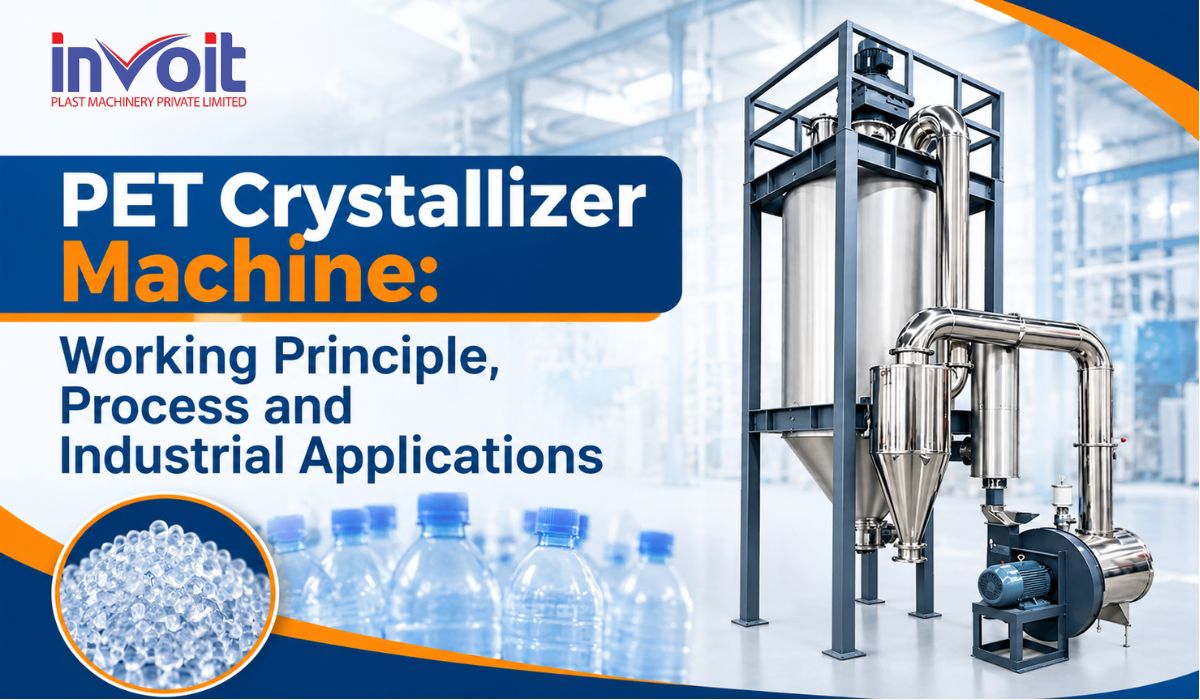
PET Crystallizer Machine: Working Principle, Process, and Industrial Applications
Polyethylene Terephthalate (PET) is a widely used thermoplastic polymer, utilized extensively in beverage packaging, thermoformed sheets, synthetic fibers, and industrial strapping. However, processing PET—especially post-consumer recycled PET (rPET) flakes and amorphous virgin resins—presents a specific operational challenge: moisture sensitivity combined with thermal softening.
When amorphous PET resin is heated directly inside standard drying hoppers or extruders, it transitions into a soft, tacky state and forms large agglomerates (clumps). This disrupts material flow, creates heavy bridging in feed hoppers, and leads to inconsistent melt extrusion.
To prevent agglomeration and ensure reliable downstream processing, plastics processing operations integrate a dedicated PET Crystallizer Machine. This comprehensive technical guide explains the working principle, step-by-step process flow, and key industrial applications of PET crystallization.
What is PET Crystallization and Why is it Necessary?
To understand how a PET crystallizer machine works, it is essential to examine the physical structure of Polyethylene Terephthalate polymer chains.
PET exists in two distinct structural states:
- Amorphous State: The polymer chains are randomly arranged and unaligned. Amorphous PET is clear, has lower thermal resistance, and softens easily when thermal energy is applied.
- Semi-Crystalline State: The polymer chains are tightly packed and highly ordered. Semi-crystalline PET appears translucent or opaque, offers higher heat resistance, and remains non-tacky at elevated drying temperatures.
The Thermal Behavior of Amorphous PET
When raw amorphous PET pellets or rPET regrind flakes are heated past their glass transition point, the molecular chains gain mobility, causing particle surfaces to become sticky. If the resin is heated in a stationary vessel without mechanical agitation, the particles fuse together into solid blocks.
PET crystallization is a thermo-mechanical process that converts amorphous material into a semi-crystalline state before final dehumidifying drying or extrusion. Crystallization increases the heat distortion resistance of the polymer, allowing it to be dried at optimal processing temperatures without clumping.
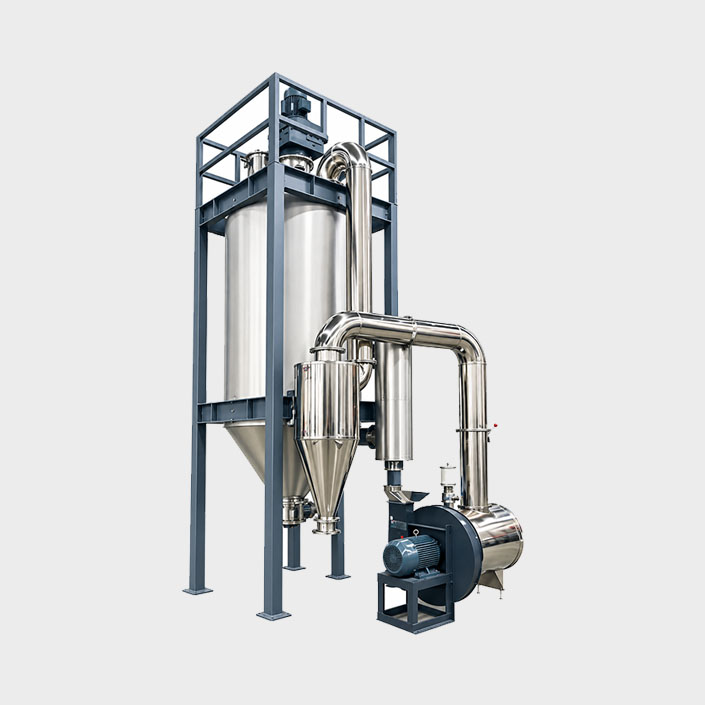
PET Crystallizer Machine Working Principle
The primary objective of a PET crystallizer machine is to elevate the temperature of amorphous PET into its optimal crystallization phase while maintaining continuous mechanical movement to prevent particle fusion.
Core Operational Factors: Heat, Agitation, and Airflow
A PET crystallizer operates by balancing three core process parameters:
- Controlled Thermal Input: Heated air is introduced through a distribution system at the base of the hopper, transferring thermal energy directly through the PET material bed to trigger molecular alignment.
- Mechanical Agitation: A high-torque agitator rotates continuously within the hopper. Specially designed agitator blades exert shear force on particle contact points, keeping the softening polymer in constant motion during its tacky phase.
- Regulated Discharge: As the polymer transitions into a crystalline structure, it moves downward toward the hopper outlet, discharging at a controlled rate into downstream drying or extrusion equipment.
Without continuous mechanical stirring during heating, softening resin quickly forms monolithic clumps. Continuous agitation ensures even heat distribution across all particles while mechanically preventing agglomeration.
Difference Between PET Crystallization and PET Drying
PET crystallization and PET drying are often discussed together because they can be consecutive stages in material preparation.
However, they perform different functions.
|
Basis |
|
PET Crystallization |
PET Drying |
|
Main purpose |
|
Changes the internal structure of PET |
Removes moisture from PET |
|
Main process |
|
Development of crystalline regions |
Moisture removal |
|
Main concern |
|
Material softening and sticking during subsequent heating |
Moisture-related degradation during melt processing |
|
Processing role |
|
Prepares suitable amorphous PET for further heating |
Prepares PET for moisture-sensitive processing |
|
Result |
|
PET with developed crystalline regions |
PET with reduced moisture content |
These operations should not be treated as interchangeable.
For example, crystallized PET may still contain moisture and require drying before extrusion or injection moulding.
Similarly, not every PET material requires crystallization before drying. The requirement depends on the material’s existing structure and the intended process.
Step-by-Step PET Crystallization Process
The continuous PET crystallization process follows a structured sequence designed to handle various material forms, including bottle flakes, regrind, and virgin amorphous pellets.
1. Material Loading
Amorphous PET resin or washed rPET regrind is fed into the top inlet of the crystallizer vessel using pneumatic loaders or volumetric feeders.
2. Thermal Airflow Circulation
A blower forces heated process air into the lower section of the hopper cone. As the hot air moves upward through the material column, it steadily elevates the core temperature of the PET resin past its glass transition state.
3. Continuous Mixing and Agitation
Inside the vessel, agitator arms turn continuously. This mixing action performs two critical roles:
- Thermal Uniformity: Prevents hot spots and temperature stratification within the material bed.
- Agglomeration Prevention: Mechanically breaks temporary surface bonds between softening particles to keep the material free-flowing.
4. Phase Realignment (Crystallization)
When the polymer bed reaches the optimal crystallization temperature, the internal polymer chains realign into an ordered crystalline lattice. The material physically changes from clear/translucent to opaque, signaling structural stability.
5. Controlled Discharge
The fully crystallized, non-tacky PET discharges continuously through a bottom rotary valve or slide gate. The material can now enter high-temperature dehumidifying hoppers without any risk of hopper bridging.
Process Advantages of PET Crystallization
Integrating a dedicated crystallizer into polymer processing lines offers key operational benefits:
- Elimination of Hopper Bridging: Prevents operational interruptions caused by fused resin blocking hopper outlets and drying vessels.
- Higher Allowable Drying Temperatures: Enables safe drying at elevated temperatures, facilitating thorough moisture removal prior to melt processing.
- Protection of Intrinsic Viscosity (IV): Effective drying following crystallization minimizes hydrolytic degradation during melt processing, helping maintain polymer chain integrity.
- Stable Processing of Recycled Material (rPET): Post-consumer flakes vary in bulk density and thermal history. Crystallization homogenizes material behavior, making rPET processing predictable.
- Reduced Thermal Load on Extruders: Pre-heating material inside the crystallizer reduces the thermal energy required from the main extruder barrel.
Industrial Applications of PET Crystallizers
PET crystallizer machines are fundamental auxiliary units across numerous polymer conversion and recycling operations:
1. PET Sheet Extrusion & Thermoforming
In rigid packaging sheet production, maintaining consistent melt strength and uniform viscosity is essential for sheet clarity and thickness control. Pre-crystallizing raw material feeds prevents feeding fluctuations.
2. Recycled PET (rPET) Repelletizing
Washed post-consumer bottle flakes are light and amorphous. Crystallizing rPET flakes stabilizes their bulk density and thermal resistance before compounding or pelletizing.
3. Polyester Staple Fiber (PSF) and Filament Production
Spinning synthetic yarns demands steady intrinsic viscosity. Removing moisture through pre-crystallization prevents polymer degradation and reduces filament breakage during spinning.
4. PET Industrial Strapping Lines
High-tensile strapping requires consistent orientation and structural integrity. Crystallized PET resin ensures predictable melt behavior and uniform draw ratios during extrusion.
Key Operating Parameters for Process Stability
To maintain consistent crystallinity and prevent operational interruptions, equipment operators should monitor the following parameters:
- Agitator Timing and Motion: Agitation must be active before material reaches glass transition temperatures. Interruptions in mixing while hot will lead to rapid agglomeration.
- Airflow Uniformity: Clean air filters and balanced distribution cones ensure even heat transfer across the hopper volume.
- Residence Time: Material must remain in the active thermal zone long enough to achieve uniform crystallization throughout each particle.
- Regrind-to-Virgin Ratios: Flakes and pellets have different bulk densities and thermal absorption characteristics; mixing speeds and temperature settings should be calibrated accordingly.
Summary & Technical Evaluation
Understanding the PET crystallizer working principle is vital for optimizing polymer preparation, protecting material properties, and maximizing recycled content integration. By balancing heat transfer, mechanical mixing, and residence time, processors can reliably transform sticky amorphous resins into stable, free-flowing crystalline stock.
Whether managing post-consumer recycling streams, sheet extrusion, or packaging production, selecting suitable auxiliary systems ensures overall line efficiency and reliable throughput.
For detailed equipment specifications, custom hopper capacities, and integration requirements for commercial production lines, review engineered processing systems on the dedicated Invoit Plast PET Crystallizer Machine product page.
Technical Consultation & Support
Selecting the right crystallization setup depends on specific throughput requirements, material forms, and downstream equipment configurations.
For tailored process guidance and equipment selection suited to your plant setup, contact the technical engineering team at Invoit Plast to discuss your production requirements.
FAQs
A PET Crystallizer Machine is an industrial plastic processing machine used to convert amorphous PET pellets or recycled PET flakes into a semi-crystalline state. It uses controlled heating and continuous mechanical agitation to prevent material particles from sticking together during heating. This prepares PET for further drying and downstream processing.
The PET crystallizer working principle is based on controlled heat transfer and continuous mechanical agitation. Heated air passes through the PET material while an agitator continuously mixes the particles. This allows the polymer structure to develop crystalline regions while preventing softening particles from forming large clumps.
PET crystallization is necessary when amorphous PET becomes sticky at elevated temperatures. Without crystallization and proper agitation, the material may stick together and cause hopper bridging. Crystallization improves the material's thermal stability, allowing it to undergo subsequent high-temperature drying more effectively.
A PET Crystallizer Machine changes the physical structure of amorphous PET by developing crystalline regions, whereas a PET Dryer removes moisture from the material. Both processes serve different purposes. Crystallized PET may still contain moisture and require dehumidifying drying before extrusion or injection moulding.
A PET crystallizer prevents material agglomeration through continuous mechanical mixing during controlled heating. Its rotating agitator keeps softening PET particles moving and helps break temporary surface bonds. This reduces particle fusion and helps maintain consistent material flow inside the hopper.
A PET Crystallizer Machine can process suitable amorphous PET materials, including virgin PET pellets, recycled PET flakes and PET regrind. The appropriate operating conditions depend on the material's physical characteristics, bulk density and processing requirements.
PET crystallizer machines are used in several plastic processing industries, including:
- Recycled PET (rPET) recycling and repelletizing.
- PET sheet extrusion and thermoforming.
- Polyester staple fibre and filament production.
- PET industrial strapping manufacturing.
These applications require stable PET material preparation before downstream processing.
A PET Crystallizer Machine helps recycling plants prepare amorphous PET flakes and regrind for further processing. It reduces material sticking during heating, supports consistent material flow and prepares recycled PET for subsequent dehumidifying drying, compounding or pelletizing operations.
Continuous agitation is important because amorphous PET becomes soft and sticky when heated above its glass transition temperature. Without proper mixing, particles can stick together and form large agglomerates. Continuous movement supports uniform heat distribution and helps maintain free-flowing material.
The main operating parameters include:
- Agitator timing and motion: Ensures continuous material movement during heating.
- Airflow uniformity: Supports consistent heat distribution.
- Residence time: Allows sufficient time for crystallization.
- Material characteristics: Different PET flakes and pellets may require different operating conditions.
Monitoring these factors helps maintain process stability and reduce material handling problems.
Not necessarily. Crystallization and drying are separate processes. Crystallization changes the physical structure of PET but does not necessarily remove its moisture. PET generally requires appropriate drying when moisture-sensitive downstream processes, such as extrusion or injection moulding, demand it.
Selecting a suitable PET Crystallizer Machine depends on the type of PET material, required processing capacity, material bulk density, downstream equipment and production requirements. Manufacturers should also evaluate hopper capacity, heating arrangements, agitator design, airflow distribution and integration with existing drying or extrusion systems.