
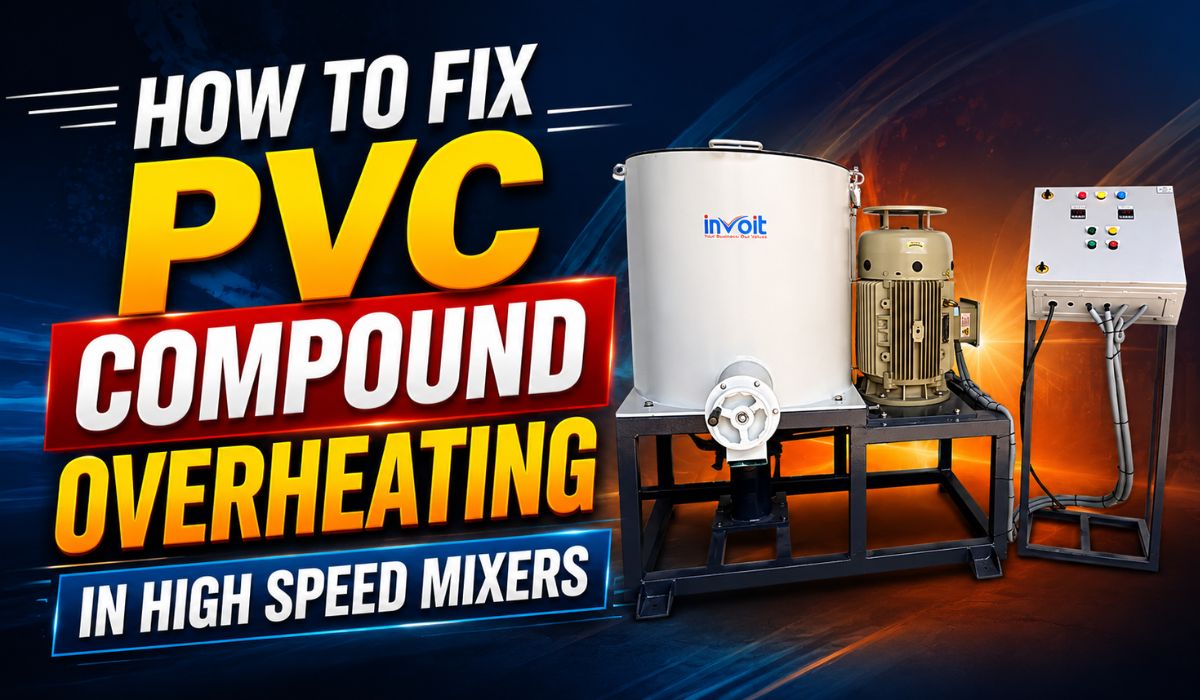
How to Fix PVC Compound Overheating in High Speed Mixers
If you run a PVC compounding, pipe extrusion, or profile manufacturing plant, you know that temperature control is the thin line between a perfect batch and a costly waste.
One of the most common and frustrating problems on the factory floor is when the PVC compound overheats inside your High Speed Mixer Machine. When PVC overheats during the mixing cycle, it does not just ruin the look of your compound. It degrades the polymer, releases hazardous fumes, damages your equipment, and eats away at your profit margins.
If you are currently facing PVC discoloration, black spots, clumping, or premature gelling during your mixing cycle, this guide is for you. As a leading High Speed Mixer Machine Manufacturer in India, Invoit Plast has helped hundreds of processors optimize their mixing lines.
Below, we break down why your plastic mixer machine is overheating your PVC compound, how this compares across different machinery designs, and give you a step-by-step diagnostic checklist to fix it immediately.
Why PVC is Highly Sensitive to Heat
Before jumping into the troubleshooting steps, we must understand the behavior of the material inside the vessel. Unplasticized PVC (uPVC) and flexible PVC are highly heat-sensitive polymers. Unlike other plastics that melt cleanly under direct heat, PVC has an incredibly narrow processing window.
During the mixing stage in a PVC Compound high speed mixer machine, two types of heat are introduced to the raw material:
- Thermal Heat: Heat supplied externally, such as from a jacketed vessel using hot water or oil. However, most modern high-speed mixers rely very little on external heat for the hot mixing cycle.
- Frictional (Shear) Heat: Heat generated by the rapid collision of PVC resin particles, fillers, stabilizers, and processing lubricants against each other and against the high-speed rotating blades (impellers).
If the internal temperature of the pvc mixer machine crosses the safety limit—typically between 110°C to 120°C for dry blends, depending on your specific formulation—the chemical stabilizers in the compound start to exhaust.
Once these stabilizers are fully consumed, the polymer begins to degrade. This thermal degradation releases toxic hydrochloric acid (HCl) gas, turns the compound yellow or dark brown, and causes the material to stick to the walls of the mixer vessel. This is what operators call a “burnt batch,” and it can stop your entire production line for hours of cleaning.
7 Common Reasons Why Your PVC Compound is Overheating
Many factory managers assume that overheating is simply a matter of running the mixer for too many seconds. However, the root cause is usually a combination of mechanical wear, material formulation issues, or design limitations found in basic standard mixers.
Here are the seven most common reasons your plastic mixer machine is overheating your material.
1. Worn-Out or Incorrectly Angled Mixing Blades
The blades (or impellers) of your High Speed Mixer Machine are responsible for lifting, folding, and fluidizing the heavy PVC powder. Over time, abrasive fillers like calcium carbonate wear down the edges of these stainless-steel blades.
When blades lose their aerodynamic profile, they can no longer lift the material efficiently to create a smooth, swirling vortex. Instead of lifting the powder, the worn blades drag through the compound. This dragging creates massive frictional heat without actually mixing the material, causing a rapid, localized temperature spike at the bottom of the vessel.
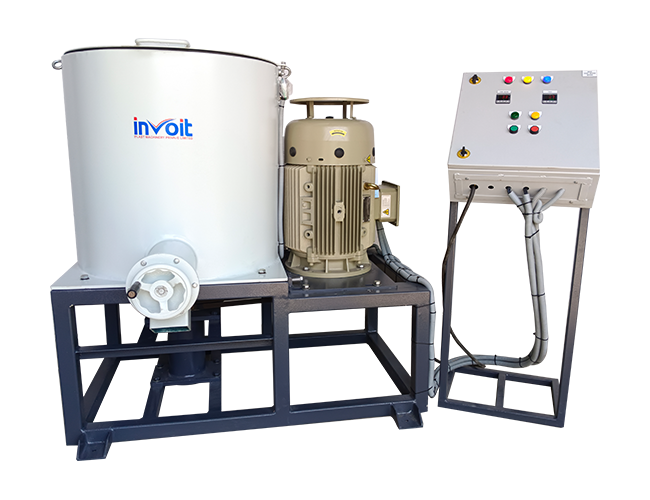
2. Inefficient Cooling Mixer Performance
The mixing process is a two-step system: a hot mixer and a cooling mixer. After the hot mixing cycle reaches its target temperature (usually 110°C–115°C), the compound must be quickly discharged into the cooling plastic mixer machine to drop the temperature safely below 45°C–50°C.
If your cooling mixer has scaling, rust, or poor water circulation in its cooling jacket, the heat transfer fails. If the hot compound sits in the cooling mixer for too long without dropping temperature, it continues to bake, leading to clumping and thermal degradation.
3. Incorrect Batch Sizes (Overloading or Underloading)
There is a common misconception on the shop floor that underloading a mixer will keep it cool. In reality, both extremes cause severe overheating:
- Overloading: Puts extreme strain on the motor and creates excessive friction because the material has no room to expand, circulate, and breathe.
- Underloading: If the raw material level is too low, the blades spin through a thin layer of powder. This concentrates all the motor’s kinetic energy and friction into a very small volume of PVC, causing an instant, uncontrollable spike in temperature.
4. Delayed or Faulty Temperature Sensors (Thermocouples)
Your pvc mixer machine relies on a thermocouple to tell the automated PLC control panel when to discharge the batch. If this sensor is coated with a layer of baked-on PVC crust, or if it is positioned incorrectly, it will suffer from “thermal lag.”
The sensor might read 110°C on the control screen, but the actual core temperature of the powder could be 125°C. By the time the pneumatic discharge valve opens, the batch is already burnt.
5. Poor Charging Sequence of Raw Materials
Adding ingredients in the wrong order can cause immediate friction spikes. For example, if you throw in heavy calcium carbonate filler right at the start with the PVC resin, the abrasive powder increases the friction on the blades from the first second.
Lubricants and stabilizers need to be added at the correct temperatures to coat the PVC grains properly. If they are added too late, there won’t be enough lubrication to control the frictional heat generated by the spinning blades.
6. Leaking Discharge Valves
If the discharge valve at the bottom of your hot mixer does not seal perfectly, material slowly leaks out, or air is drawn in. This disrupts the pressure and material vortex inside.
More importantly, material trapped in the clearance spaces of a leaking valve does not circulate. It stays in one spot, gets subjected to continuous friction, overheats, degrades, and then acts as a burnt “catalyst” for the rest of the batch.
7. Incorrect Blade Clearance (The “Dead Zone” Problem)
There is a critical gap between the bottom-most mixing blade and the bottom dish of the mixer vessel. If this clearance gap is too wide—either due to poor manufacturing tolerances or improper maintenance—a layer of PVC compound gets trapped underneath the blade.
This trapped material does not move with the vortex. It stays static, absorbs massive frictional heat, burns, and continuously contaminates your fresh batches with black specks.
Standard Competitor Mixers vs. Engineered High-Speed Mixers
When setting up a PVC compounding plant, it is tempting to choose a low-cost, generic plastic mixer machine from local, unorganized workshops. However, these budget options often lack the engineering precision required for sensitive polymer processing.
To help you understand why these overheating issues occur more frequently on standard machines, let us look at how generic workshop mixers compare to highly engineered systems.
|
Design Feature |
Standard Workshop Mixers |
Precision-Engineered Mixers (Like Invoit Plast) |
|
Blade Aerodynamics |
Simple flat or slightly bent steel plates that drag through the powder. |
Dynamically balanced, aerodynamically contoured blades designed to fluidize the material smoothly with minimal resistance. |
|
Vessel Geometry |
Single-welded vessels with manual polishing, which can develop cold or hot spots. |
CNC-machined, high-polish SS304/SS316 vessels with double-jacketed precision cooling options for uniform heat distribution. |
|
Temperature Tracking |
Slow-response, budget thermal sensors prone to thermal lag and frequent failures. |
Dual, ultra-sensitive, fast-response thermocouples that feed real-time temperature data directly to automated PLC panels. |
|
Shaft Sealing |
Basic gland packing that wears out quickly, leading to powder leakage and bearing friction. |
Advanced air-purged multi-labyrinth seals that prevent powder leakage and keep mechanical heat away from the vessel. |
|
Blade Wear Resistance |
Standard mild steel or basic stainless steel that wears down quickly under abrasive filler loading. |
High-grade stainless steel with specialized wear-resistant hard-facings (like tungsten carbide coating) to withstand heavy calcium carbonate use. |
By choosing a trusted High Speed Mixer Machine Manufacturer like Invoit Plast, you invest in a machine designed to prevent overheating before it ever starts. Our advanced thermal management systems ensure that your PVC dry blend is mixed faster, consuming less energy while maintaining perfect compound integrity.
Step-by-Step Diagnostic Checklist to Stop PVC Overheating
If your production line is currently suffering from burnt batches or discoloration, do not panic. Run through this practical, step-by-step diagnostic checklist to get your High Speed Mixer Machine back to peak performance.
Step 1: Inspect and Recalibrate the Thermocouple
- Why it matters: A blinded or lagging sensor is the number one cause of unexpected burnt batches.
- The Action: Turn off the machine, follow safety lockout-tagout (LOTO) protocols, and open the mixing vessel lid. Locate the temperature probe (usually protruding from the side wall or the bottom).
- The Fix: Clean off any crust, stabilizer buildup, or plastic residue from the tip of the probe. Next, run a test batch. Use a handheld digital infrared thermometer to measure the physical temperature of the powder immediately upon discharge. Compare this with the temperature shown on your PLC screen. If there is a difference of more than 2°C to 3°C, recalibrate or replace the thermocouple immediately.
Step 2: Measure and Adjust Blade-to-Vessel Clearance
- Why it matters: Large clearances create stagnant “dead zones” where PVC burns.
- The Action: Use a feeler gauge or clearance block to measure the distance between the tip of the lowest mixing blade and the bottom wall of the vessel.
- The Fix: This gap should typically be kept within 2mm to 3mm (refer to your manual for exact specifications). If the gap is wider, adjust the height of the blade shaft. If the blades are rounded, thin, or chipped from years of mixing abrasive fillers, replace them with a fresh, dynamically balanced set.
Step 3: Optimize Your Material Charging Sequence
- Why it matters: Adding raw materials in the wrong order spikes friction too early in the cycle.
- The Action: Review your operator’s charging sequence.
- The Fix: Implement the following industry-proven sequence:
- Charge 1: Add PVC resin and active stabilizers at the very start. Run the mixer. The stabilizers must coat the PVC pores as the temperature rises to about 60°C–70°C.
- Charge 2: Add processing aids, internal lubricants, and impact modifiers around 75°C–80°C. This allows the lubricants to melt and coat the particles, reducing internal friction.
- Charge 3: Add external lubricants and pigments around 85°C–90°C.
- Charge 4: Finally, add heavy, abrasive fillers (like calcium carbonate) at around 90°C–95°C. Adding fillers late in the cycle prevents them from causing unnecessary friction and blade wear during the early stages of mixing.
Step 4: Verify the Chilled Water Flow in Your Cooling Mixer
- Why it matters: If the cooling mixer cannot remove heat quickly, the residual heat will degrade the compound.
- The Action: Check the inlet and outlet water pressure and temperature on your cooling mixer’s jacket.
- The Fix: There should be a noticeable temperature difference between the water entering the jacket and the water leaving it. If both temperatures are nearly identical, the heat is not being transferred from the hot PVC powder to the cooling water. This is usually caused by hard-water scale buildup inside the cooling jacket. Flush the jacket with mild descaling agents to restore maximum heat transfer.
Step 5: Check Drive Belt Tension and Motor Load
- Why it matters: Slipping belts cause prolonged mixing cycles, which subjects the material to unnecessary friction over a longer period.
- The Action: Inspect the drive belts under the mixer and monitor the motor’s current draw (Amperes) on the control panel.
- The Fix: If the drive belts are loose, they will slip under heavy loads, causing the blade RPM to drop. This ruins the material vortex and extends the mixing time. Tighten the belts to the manufacturer’s recommended tension. If the motor is drawing abnormally high current, check if the vessel is overloaded or if the main shaft bearings are overheating.
Daily and Weekly Maintenance Habits to Prevent Overheating
In the PVC compounding industry, preventative maintenance is always cheaper than correcting a ruined batch. Incorporate these simple habits into your team’s schedule to keep your production running smoothly:
- Daily Vessel Cleaning: At the end of every shift, or when changing recipes, clean the inside of the mixing vessel thoroughly. Any leftover PVC crust on the walls or blades will act as a heat insulator and a catalyst, accelerating the degradation of the next batch.
- Daily Valve Inspection: Clean the discharge valve assembly daily. Ensure the pneumatic cylinder operates smoothly and the valve gate closes tightly without leaving any gaps.
- Weekly Shaft Seal Checks: Check the air-purging pressure of the shaft seals. Proper air pressure prevents fine PVC powder from entering the seal housing, which prevents friction-induced heating at the base of the shaft.
- Monthly Dynamic Balancing: Have your maintenance team check the alignment and balance of the mixing shaft. An unbalanced shaft vibrates, creating mechanical heat in the bearings that transfers directly into the mixing bowl and overheats the material.
Partner with India's Trusted High Speed Mixer Machine Manufacturer
Fixing PVC compound overheating is not just about adjusting a dial on your control panel. It is about operating a machine that is engineered to handle the complex physics of polymer compounding.
At Invoit Plast, we do not just build machinery—we engineer complete manufacturing solutions. Our state-of-the-art High Speed Mixer Machines are designed with precision-contoured blades, highly efficient cooling jackets, air-purged shaft seals, and intelligent automated control panels to keep your production cycles fast, safe, and highly profitable.
Whether you are looking to upgrade your existing compounding line, resolve recurring material degradation issues, or export robust polymer processing setups globally, our team of industrial experts is here to support you.
Ready to Eliminate PVC Overheating in Your Plant?
Let us help you optimize your mixing cycles, reduce scrap rates, and select the perfect machinery for your plant’s capacity.
- Inquire Online: Send us your batch size and formulation requirements, and our engineers will share a customized layout and equipment recommendation.
- Call Our Engineering Experts: Connect directly with an Invoit Plast technical specialist to diagnose your current mixing line challenges.
- Global Exports & Support: We manufacture and export heavy-duty compounding systems worldwide with full operational support. Contact us today for export details.
Contact Invoit Plast today—Your trusted partner in high-performance polymer compounding technology.
📩 Request Your Quotation Now
+91 63546 02502 , info@invoitplast.com
FAQs
Color change (yellowing or browning) is a clear indicator of thermal degradation. It happens when the PVC compound overheats beyond its stable limit (usually above 120°C) or is subjected to prolonged shear heat. When this happens, the chemical stabilizers are completely consumed, causing the polymer to release hydrochloric acid (HCl) and degrade. To prevent this, ensure your temperature sensors are properly calibrated and that the mixing cycle does not run too long due to slipping drive belts.
For most standard rigid PVC (uPVC) formulations, the ideal discharge temperature from the hot High Speed Mixer Machine is between 110°C and 115°C. For highly filled or flexible PVC compounds, it may go up to 120°C. Discharging within this range ensures that all processing lubricants have melted and coated the PVC particles uniformly without initiating thermal degradation.
Invoit Plast is highly regarded as a leading High Speed Mixer Machine Manufacturer in India. They design precision-engineered mixing systems specifically optimized to handle heat-sensitive polymers. Unlike local fabrication workshops, Invoit Plast focuses on dynamic blade balancing, CNC-machined vessel geometry, and advanced air-purged multi-labyrinth seals to prevent powder friction and premature compound overheating.
If the gap between the bottom blade and the vessel dish is wider than 2mm to 3mm, a stagnant "dead zone" is created. PVC powder gets trapped in this space and cannot lift into the mixing vortex. Subjected to continuous mechanical friction, this trapped material overheats, burns, turns black, and gradually chips off into fresh batches, causing persistent black spots in the final product.
You can identify worn-out blades by three key signs:
- Longer mixing cycle times to reach the target temperature.
- Localized overheating at the bottom of the vessel while the top material remains cool.
- Rounded, blunt, or thin blade profiles upon visual inspection. Replacing worn blades with dynamically balanced, wear-resistant impellers restores the vortex lift and reduces unnecessary frictional heat.
Yes, absolutely. Underloading is a major cause of rapid, uncontrollable temperature spikes. When the vessel is underloaded, the high-speed rotating blades transfer all of the motor's kinetic energy into a very small volume of raw material. Without enough material volume to absorb and distribute the physical impact, the localized frictional heat spikes almost instantly, burning the batch.
Fine PVC powder and abrasive calcium carbonate fillers can easily slip down the mixing shaft and enter the bearing housing. This abrasive dust creates extreme mechanical friction and heat, which transfers straight up the shaft and overheats the mixing bowl. Air-purged labyrinth seals inject pressurized air into the seal gap, creating a continuous barrier that blocks powder entry and keeps the mechanical assembly running cool.
Slow cooling performance is usually caused by poor heat transfer inside the cooling jacket. This happens due to hard-water scaling or rust buildup inside the jacket channels, or insufficient chilled water flow rate. If the hot compound (at 110°C) sits in the cooling mixer for too long, the residual heat will continue to cook the polymer, causing severe clumping and material yellowing. Regular descaling of the cooling jacket is highly recommended.
Adding all raw materials at once causes massive, immediate mechanical resistance and friction. Heavy, abrasive fillers like calcium carbonate should always be added late in the mixing cycle (around 90°C–95°C). Adding them too early wears down the blades quickly and increases friction right from the start. Adding stabilizers and lubricants first allows them to melt and coat the PVC grains, which naturally lubricates the batch and controls frictional heat.
Modern high-speed mixers manufactured by precision engineering brands like Invoit Plast use fast-response dual thermocouples connected directly to automated PLC panels. This setup eliminates human error. As soon as the material reaches the exact target temperature, the PLC automatically opens the pneumatic discharge valve, instantly dropping the batch into the cooling mixer and completely preventing the risk of a "burnt batch."